
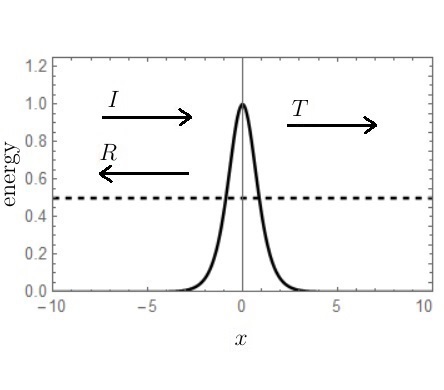
One of the more complicated-looking Schrödinger wavefunctions arises from a scattering (i.e., positive energy) problem involving an Eckart potential. These wavefunctions are expressed in terms of Gauss hypergeometric functions and as part of some numerical work I was doing using Maple software I wanted to see how easy or difficult it would be to write a Maple procedure that would compute and plot these objects. It turned out to be not too difficult and I want to record this Maple code in the present note. The following diagram illustrates the basic setup for scattering from an Eckart potential that will be considered here.
The Eckart potential was first introduced in 1930 (Eckart, C, 1930, The penetration of a potential barrier by electrons, Phys Rev 35, Issue 11, pp. 1303-1309) and has the form

where 


The time-independent Schrödinger equation for scattering from an Eckart potential of this form can be written as
![-\frac{\hbar^2}{2m} \frac{d^2\psi}{dx^2} + \bigg[\frac{V_0}{\cosh^2\big(\frac{x}{a}\big)} - E\bigg]\psi = 0](https://s0.wp.com/latex.php?latex=-%5Cfrac%7B%5Chbar%5E2%7D%7B2m%7D+%5Cfrac%7Bd%5E2%5Cpsi%7D%7Bdx%5E2%7D+%2B+%5Cbigg%5B%5Cfrac%7BV_0%7D%7B%5Ccosh%5E2%5Cbig%28%5Cfrac%7Bx%7D%7Ba%7D%5Cbig%29%7D+-+E%5Cbigg%5D%5Cpsi+%3D+0&bg=ffffff&fg=111111&s=2&c=20201002)
To rescale this for numerical work we can divide through by 
![\frac{1}{2} \frac{d^2\psi}{dx^2} + [E^{\prime} - V^{\prime}]\psi = 0](https://s0.wp.com/latex.php?latex=%5Cfrac%7B1%7D%7B2%7D+%5Cfrac%7Bd%5E2%5Cpsi%7D%7Bdx%5E2%7D+%2B+%5BE%5E%7B%5Cprime%7D+-+V%5E%7B%5Cprime%7D%5D%5Cpsi+%3D+0&bg=ffffff&fg=111111&s=2&c=20201002)
where

and

To obtain 

This is a second-order linear ordinary differential equation with a travelling wave solution of the general form

where 


To obtain 


which is of unit height and width. This is the setup shown in the diagram above. Therefore the scattering equation we will be implementing to begin with is
![\frac{1}{2} \frac{d^2\psi}{dx^2} + \bigg[\frac{1}{2} - \frac{1}{\cosh^2(x)}\bigg]\psi = 0](https://s0.wp.com/latex.php?latex=%5Cfrac%7B1%7D%7B2%7D+%5Cfrac%7Bd%5E2%5Cpsi%7D%7Bdx%5E2%7D+%2B+%5Cbigg%5B%5Cfrac%7B1%7D%7B2%7D+-+%5Cfrac%7B1%7D%7B%5Ccosh%5E2%28x%29%7D%5Cbigg%5D%5Cpsi+%3D+0&bg=ffffff&fg=111111&s=2&c=20201002)
This quantum system can be solved exactly in terms of Gauss hypergeometric functions of the form ![{}_2F_1\big([\alpha, \beta], [\gamma], z\big)](https://s0.wp.com/latex.php?latex=%7B%7D_2F_1%5Cbig%28%5B%5Calpha%2C+%5Cbeta%5D%2C+%5B%5Cgamma%5D%2C+z%5Cbig%29&bg=ffffff&fg=111111&s=2&c=20201002)


![\lambda = \frac{1}{4}\bigg[\sqrt{1 - \frac{8mV_0a^2}{\hbar^2}} - 1\bigg]](https://s0.wp.com/latex.php?latex=%5Clambda+%3D+%5Cfrac%7B1%7D%7B4%7D%5Cbigg%5B%5Csqrt%7B1+-+%5Cfrac%7B8mV_0a%5E2%7D%7B%5Chbar%5E2%7D%7D+-+1%5Cbigg%5D&bg=ffffff&fg=111111&s=2&c=20201002)


Then the exact solution of the general time-independent Schrödinger equation for this problem is the wavefunction
![\psi = \bigg[\cosh^2\bigg(\frac{x}{a}\bigg)\bigg]^{-2\lambda}\cdot{}_2F_1\bigg(\bigg[-\lambda+\frac{ika}{2}, -\lambda - \frac{ika}{2}\bigg], \bigg[\frac{1}{2}\bigg], -\sinh^2\bigg(\frac{x}{a}\bigg)\bigg)](https://s0.wp.com/latex.php?latex=%5Cpsi+%3D+%5Cbigg%5B%5Ccosh%5E2%5Cbigg%28%5Cfrac%7Bx%7D%7Ba%7D%5Cbigg%29%5Cbigg%5D%5E%7B-2%5Clambda%7D%5Ccdot%7B%7D_2F_1%5Cbigg%28%5Cbigg%5B-%5Clambda%2B%5Cfrac%7Bika%7D%7B2%7D%2C+-%5Clambda+-+%5Cfrac%7Bika%7D%7B2%7D%5Cbigg%5D%2C+%5Cbigg%5B%5Cfrac%7B1%7D%7B2%7D%5Cbigg%5D%2C+-%5Csinh%5E2%5Cbigg%28%5Cfrac%7Bx%7D%7Ba%7D%5Cbigg%29%5Cbigg%29&bg=ffffff&fg=111111&s=0&c=20201002)
![-\frac{a_1}{a_2} \bigg[\cosh\bigg(\frac{x}{a}\bigg)\bigg]^{-2\lambda} \cdot \sinh\bigg(\frac{x}{a}\bigg)\cdot{}_2F_1\bigg(\bigg[-\lambda+\frac{ika}{2}+\frac{1}{2}, -\lambda - \frac{ika}{2}+\frac{1}{2}\bigg], \bigg[\frac{3}{2}\bigg], -\sinh^2\bigg(\frac{x}{a}\bigg)\bigg)](https://s0.wp.com/latex.php?latex=-%5Cfrac%7Ba_1%7D%7Ba_2%7D+%5Cbigg%5B%5Ccosh%5Cbigg%28%5Cfrac%7Bx%7D%7Ba%7D%5Cbigg%29%5Cbigg%5D%5E%7B-2%5Clambda%7D+%5Ccdot+%5Csinh%5Cbigg%28%5Cfrac%7Bx%7D%7Ba%7D%5Cbigg%29%5Ccdot%7B%7D_2F_1%5Cbigg%28%5Cbigg%5B-%5Clambda%2B%5Cfrac%7Bika%7D%7B2%7D%2B%5Cfrac%7B1%7D%7B2%7D%2C+-%5Clambda+-+%5Cfrac%7Bika%7D%7B2%7D%2B%5Cfrac%7B1%7D%7B2%7D%5Cbigg%5D%2C+%5Cbigg%5B%5Cfrac%7B3%7D%7B2%7D%5Cbigg%5D%2C+-%5Csinh%5E2%5Cbigg%28%5Cfrac%7Bx%7D%7Ba%7D%5Cbigg%29%5Cbigg%29&bg=ffffff&fg=111111&s=0&c=20201002)
The exact solution for our particular specifications is then obtained by setting 

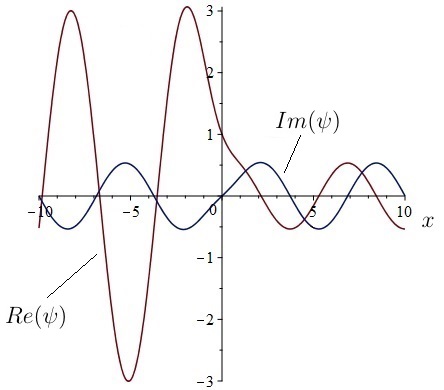
The reflection and transmission coefficients for this scattering problem are given by the formulas


Evaluating these with 


I produced the above wavefunction plot, and calculated the corresponding reflection and transmission probabilities, using the following Maple code:
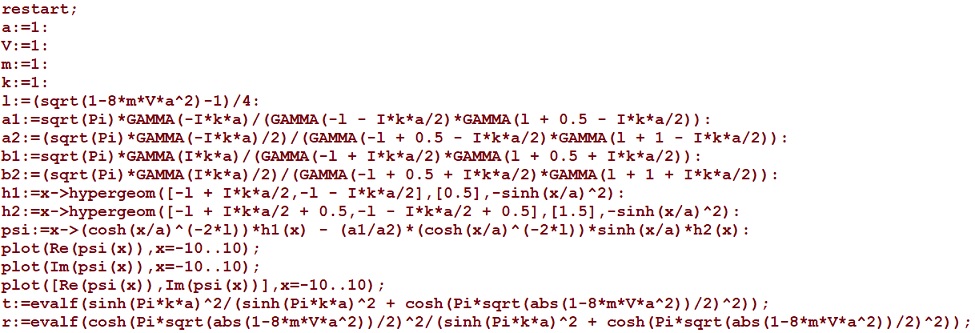
Wavefunction plots and reflection and transmission probabilities for different Eckart scattering parameters can now easily be obtained by simply varying the parameters 
 Dr Christian P. H. Salas
The expression for wave function is a little bit incorrect. In the second addendum a multiplier with cosh should be exponentiation -2*lambda
Hi Boris. Thank you for pointing out this typo. I have added the missing exponent to cosh in the second term of the wave function. (Luckily, I did not miss out this exponent when later implementing the wave function in MAPLE).