A mathematics and physics `scrapbook', with notes on miscellaneous things that catch my interest in a range of areas including: mathematical methods; number theory; probability theory; stochastic processes; mathematical economics; econometrics; quantum theory; relativity theory; cosmology; cloud physics; statistical mechanics; nonlinear dynamics; electronic engineering; graph and network theory; mathematics in Latin; computational mathematics using Python and other maths software.
Topological equivalence of the 2-sphere and the extended complex plane (the `Riemann sphere’)
In this short note I want to quickly set out the mathematical details of how the Riemann sphere arises when the point at infinity is added to the complex plane to give the extended complex plane , i.e., an explicit homeomorphism which establishes the topological equivalence of the -sphere and the extended complex plane, giving rise to the name Riemann sphere for the latter.
The -sphere in , namely
is visualised as sitting in a coordinate system with its centre at the origin, and the complex plane is identified with the plane by identifying , , with for all . The point is identified as the `north pole’ of , and stereographic projections from then give rise to a bijective map between and of the form
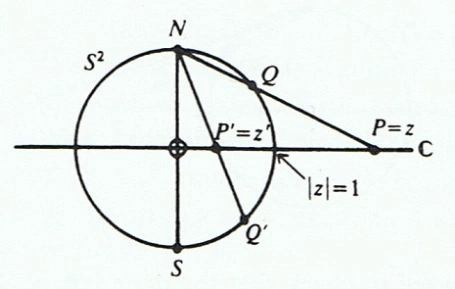
such that the points , , and are collinear (but note that we are excluding from the domain of the bijection at this stage). The situation is illustrated in the following diagram:
To show that is in fact a homeomorphism (i.e., a continuous bijection from to whose inverse is also continuous), let where , and let
Since , , and are collinear, there is some constant such that
Therefore considering the coordinates separately in this equation we have
and so
Therefore we have
and this is the map .
To get the inverse map , we observe that
(using )
Therefore is given by
These expressions show that both and are continuous, so is a homeomorphism between and , i.e., and are topologically equivalent.
To complete the picture we need to extend the homeomorphism to include the point . We do this by defining
where , known as the point at infinity, is the distinguishing feature that makes the geometry of the present context non-Euclidean (it can be viewed as the point in this geometry where lines which start out parallel eventually meet, something which is impossible in Euclidean geometry). With the addition of the point at infinity into the picture we get the full homeomorphism
between the -sphere and the extended complex plane. This explains why the extended complex plane is referred to as the Riemann sphere. It is because the extended complex plane is homeomorphic (i.e., topologically equivalent) to the -sphere in .
Intuitively, points on the -sphere which are close to the north pole correspond under to complex numbers with large magnitude , i.e., to complex numbers which are `closer to infinity’ in a sense. Similarly, points on the -sphere which are close to the south pole correspond to complex numbers with small magnitude . Points on the equator of the -sphere, which intersects the plane , correspond to the unit circle in the complex plane. The situation is illustrated in the following diagram:



 Dr Christian P. H. Salas
One thought on “Topological equivalence of the 2-sphere and the extended complex plane (the `Riemann sphere’)”