A mathematics and physics `scrapbook', with notes on miscellaneous things that catch my interest in a range of areas including: mathematical methods; number theory; probability theory; stochastic processes; mathematical economics; econometrics; quantum theory; relativity theory; cosmology; cloud physics; statistical mechanics; nonlinear dynamics; electronic engineering; graph and network theory; mathematics in Latin; computational mathematics using Python and other maths software.
Changing variables in the square of the angular momentum operator
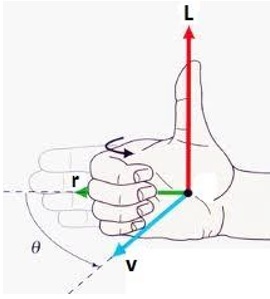
A particle of mass with position vector and velocity (with respect to some specified origin) has a linear momentum vector and angular momentum vector
where is the vector product operation. The magnitude of the angular momentum vector is where is the angle between and . The direction of is given by the right-hand rule when the vectors and are placed with their tails at the same point: one curls the fingers of the right hand in the direction of rotation of into and the thumb then points in the direction of .
One can find the components of in the , and directions in Cartesian coordinates using
Therefore the components of in Cartesian coordinates are
In classical mechanics the angular momentum magnitude can take a continuum of values but in quantum mechanics only certain discrete values for are permissible. Furthermore, the linear momentum vector appearing in must obey Heisenberg’s uncertainty principle in each direction, i.e.,
in the -direction and similarly for the and directions. These features of quantized variables like and make it necessary to do calculations with them in quantum mechanics using their operator representations. (For example, on the quantum scale one cannot calculate the expectation of momentum in the direction using an integral involving momentum as a function of because no such function can exist: Heisenberg’s uncertainty principle prevents accurate knowledge of momentum when the value of is known exactly. One must therefore use the operator representation of momentum rather than momentum as some function of in order to calculate the expectation). It is a basic postulate of quantum mechanics that every observable quantity characterising a physical system can be represented by a quantum mechanical operator obtained by expressing the quantity in terms of and and then replacing the vector by where
and its components , and by
Taking this on board we can then write and , and in quantum mechanical operator form in Cartesian coordinates as
In order to perform some calculations involving Schrödinger’s equation I needed to employ the square of the quantum mechanical angular momentum operator , but in spherical polar coordinates rather than Cartesian coordinates, where
I used the matrix calculus approach in my previous note to achieve the necessary change of variables in . In the present note I want to record the details of this calculation as I have never seen this approach used elsewhere. (This change of variables can also be done using a scale factor method based on vector calculus which I will not go into here).
As in my previous note we begin the matrix calculus approach with the standard conversion equations for spherical polar coordinates:
Differentiating with respect to the vector we get
We can then use the matrix version of the chain rule to write
We can solve this system by inverting the coefficient matrix to get
Using the equations in this system together with the standard conversion equations we then have
and
Subtracting the second expression from the first and ignoring the in the numerators of the partial derivatives we can then write the angular momentum operator in the direction in terms of spherical polar coordinates as
Similarly we have
and
Therefore
Finally, we have
and
Therefore
Having obtained the components of in spherical polar coordinates we can now finally calculate the operator representation of as





![= \big[ i \hbar \big(\cot \theta \cos \phi \frac{\partial}{\partial \phi} + \sin \phi \frac{\partial}{\partial \theta} \big) \big]^2 + \big[ - i \hbar \big(\cos \phi \frac{\partial}{\partial \theta} - \cot \theta \sin \phi \frac{\partial}{\partial \phi} \big) \big]^2 + \big[ - i \hbar \frac{\partial}{\partial \phi} \big]^2](https://s0.wp.com/latex.php?latex=%3D+%5Cbig%5B+i+%5Chbar+%5Cbig%28%5Ccot+%5Ctheta+%5Ccos+%5Cphi+%5Cfrac%7B%5Cpartial%7D%7B%5Cpartial+%5Cphi%7D+%2B+%5Csin+%5Cphi+%5Cfrac%7B%5Cpartial%7D%7B%5Cpartial+%5Ctheta%7D+%5Cbig%29+%5Cbig%5D%5E2+%2B+%5Cbig%5B+-+i+%5Chbar+%5Cbig%28%5Ccos+%5Cphi+%5Cfrac%7B%5Cpartial%7D%7B%5Cpartial+%5Ctheta%7D+-+%5Ccot+%5Ctheta+%5Csin+%5Cphi+%5Cfrac%7B%5Cpartial%7D%7B%5Cpartial+%5Cphi%7D+%5Cbig%29+%5Cbig%5D%5E2+%2B+%5Cbig%5B+-+i+%5Chbar+%5Cfrac%7B%5Cpartial%7D%7B%5Cpartial+%5Cphi%7D+%5Cbig%5D%5E2&bg=ffffff&fg=111111&s=0&c=20201002)
![= - \hbar^2 \big[ \sin^2 \phi \frac{\partial^2}{\partial \theta^2} + \big(\sin \phi \frac{\partial}{\partial \theta} \big) \big(\cot \theta \cos \phi \frac{\partial}{\partial \phi} \big) + \big(\cot \theta \cos \phi \frac{\partial}{\partial \phi} \big)\big(\sin \phi \frac{\partial}{\partial \theta} \big) + \cot^2 \theta \cos^2 \phi \frac{\partial^2}{\partial \phi^2} \big]](https://s0.wp.com/latex.php?latex=%3D+-+%5Chbar%5E2+%5Cbig%5B+%5Csin%5E2+%5Cphi+%5Cfrac%7B%5Cpartial%5E2%7D%7B%5Cpartial+%5Ctheta%5E2%7D+%2B+%5Cbig%28%5Csin+%5Cphi+%5Cfrac%7B%5Cpartial%7D%7B%5Cpartial+%5Ctheta%7D+%5Cbig%29+%5Cbig%28%5Ccot+%5Ctheta+%5Ccos+%5Cphi+%5Cfrac%7B%5Cpartial%7D%7B%5Cpartial+%5Cphi%7D+%5Cbig%29+%2B+%5Cbig%28%5Ccot+%5Ctheta+%5Ccos+%5Cphi+%5Cfrac%7B%5Cpartial%7D%7B%5Cpartial+%5Cphi%7D+%5Cbig%29%5Cbig%28%5Csin+%5Cphi+%5Cfrac%7B%5Cpartial%7D%7B%5Cpartial+%5Ctheta%7D+%5Cbig%29+%2B+%5Ccot%5E2+%5Ctheta+%5Ccos%5E2+%5Cphi+%5Cfrac%7B%5Cpartial%5E2%7D%7B%5Cpartial+%5Cphi%5E2%7D+%5Cbig%5D&bg=ffffff&fg=111111&s=0&c=20201002)
![- \hbar^2 \big[ \cos^2 \phi \frac{\partial^2}{\partial \theta^2} - \big(\cos \phi \frac{\partial}{\partial \theta} \big) \big(\cot \theta \sin \phi \frac{\partial}{\partial \phi} \big) - \big(\cot \theta \sin \phi \frac{\partial}{\partial \phi} \big)\big(\cos \phi \frac{\partial}{\partial \theta} \big) + \cot^2 \theta \sin^2 \phi \frac{\partial^2}{\partial \phi^2} \big]](https://s0.wp.com/latex.php?latex=-+%5Chbar%5E2+%5Cbig%5B+%5Ccos%5E2+%5Cphi+%5Cfrac%7B%5Cpartial%5E2%7D%7B%5Cpartial+%5Ctheta%5E2%7D+-+%5Cbig%28%5Ccos+%5Cphi+%5Cfrac%7B%5Cpartial%7D%7B%5Cpartial+%5Ctheta%7D+%5Cbig%29+%5Cbig%28%5Ccot+%5Ctheta+%5Csin+%5Cphi+%5Cfrac%7B%5Cpartial%7D%7B%5Cpartial+%5Cphi%7D+%5Cbig%29+-+%5Cbig%28%5Ccot+%5Ctheta+%5Csin+%5Cphi+%5Cfrac%7B%5Cpartial%7D%7B%5Cpartial+%5Cphi%7D+%5Cbig%29%5Cbig%28%5Ccos+%5Cphi+%5Cfrac%7B%5Cpartial%7D%7B%5Cpartial+%5Ctheta%7D+%5Cbig%29+%2B+%5Ccot%5E2+%5Ctheta+%5Csin%5E2+%5Cphi+%5Cfrac%7B%5Cpartial%5E2%7D%7B%5Cpartial+%5Cphi%5E2%7D+%5Cbig%5D&bg=ffffff&fg=111111&s=0&c=20201002)


 Dr Christian P. H. Salas