
A geodesic can be defined as an extremal path between two points on a manifold in the sense that it minimises or maximises some criterion of interest (e.g., minimises distance travelled, maximises proper time, etc). Such a path will satisfy some geodesic equations equivalent to the Euler-Lagrange equations of the calculus of variations. A geodesic can also be defined in a conceptually different way as the straightest possible path between two points on a manifold. In this case the path will satisfy geodesic equations derived by requiring parallel transport of a tangent vector along the path. Although these are conceptually different ways of defining geodesics, they are mathematically equivalent. In the present note I want to explore the derivation of geodesic equations in these two different ways and prove their mathematical equivalence.
Now, in the calculus of variations we typically define a system’s action 


where 


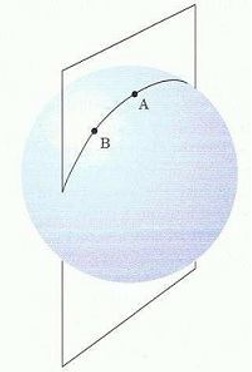
Let us now suppose that we are facing an exactly analogous situation in which there are two points on the manifold, 


we can write the length of a particular path as

Note that the metric is a function of the coordinates of points along the path, which in turn are functions of the parameter 


and we hope to find the path

This corresponds to 

We can manipulate the Euler-Lagrange equations to get geodesic equations which are easier to use in particular contexts. First, note that


because, for example, 


But notice that since

we have

so

and we can write


Next, we have


Putting these results into the Euler-Lagrange equations we get

Finally, multiplying through by 

where I have also renamed 
We will now derive a second version of the geodesic equations by requiring the geodesic to be a path that is locally straight. In differential geometry a path is defined as straight if it parallel transports its own tangent vector, i.e., if the tangent vector does not change as we move an infinitesimal step along the path. If we take an arbitrary point on the path to be 


and we want

Multiplying through by

But


Putting this into the equation gives

To enable us to factor out the basis vector we can rename the indices in the second term as 


![\big[\frac{d^2 x^{\mu}}{ds^2} + \frac{d x^{\alpha}}{ds} \frac{d x^{\beta}}{ds} \Gamma^{\mu}_{\hphantom{\mu} \alpha \beta} \big] e_{\mu} = 0](https://s0.wp.com/latex.php?latex=%5Cbig%5B%5Cfrac%7Bd%5E2+x%5E%7B%5Cmu%7D%7D%7Bds%5E2%7D+%2B+%5Cfrac%7Bd+x%5E%7B%5Calpha%7D%7D%7Bds%7D+%5Cfrac%7Bd+x%5E%7B%5Cbeta%7D%7D%7Bds%7D+%5CGamma%5E%7B%5Cmu%7D_%7B%5Chphantom%7B%5Cmu%7D+%5Calpha+%5Cbeta%7D+%5Cbig%5D+e_%7B%5Cmu%7D+%3D+0&bg=ffffff&fg=111111&s=0&c=20201002)


This is the second version of the geodesic equations, derived by assuming that the path between the two points on the manifold is locally straight.
We now have two seemingly different versions of the geodesic equations, namely
and

We will next show that they are in fact mathematically equivalent. Starting from the first version, we can expand out the brackets to get


Now we rename the indices as follows: 


We can write this as
![0 = \frac{dx^{\alpha}}{ds} \frac{dx^{\beta}}{ds} \frac{1}{2} [\partial_{\alpha} \ g_{\beta \sigma} + \partial_{\beta} \ g_{\sigma \alpha} - \partial_{\sigma} \ g_{\alpha \beta}] + g_{\sigma \mu} \frac{d^2 x^{\mu}}{ds^2}](https://s0.wp.com/latex.php?latex=0+%3D+%5Cfrac%7Bdx%5E%7B%5Calpha%7D%7D%7Bds%7D+%5Cfrac%7Bdx%5E%7B%5Cbeta%7D%7D%7Bds%7D+%5Cfrac%7B1%7D%7B2%7D+%5B%5Cpartial_%7B%5Calpha%7D+%5C+g_%7B%5Cbeta+%5Csigma%7D+%2B+%5Cpartial_%7B%5Cbeta%7D+%5C+g_%7B%5Csigma+%5Calpha%7D+-+%5Cpartial_%7B%5Csigma%7D+%5C+g_%7B%5Calpha+%5Cbeta%7D%5D+%2B+g_%7B%5Csigma+%5Cmu%7D+%5Cfrac%7Bd%5E2+x%5E%7B%5Cmu%7D%7D%7Bds%5E2%7D&bg=ffffff&fg=111111&s=0&c=20201002)
Finally, multiplying through by 

and
![\Gamma^{\mu}_{\hphantom{\mu} \alpha \beta} = \frac{1}{2} g^{\mu \sigma} [\partial{\alpha} \ g_{\beta \sigma} + \partial_{\beta} \ g_{\sigma \alpha} - \partial_{\sigma} \ g_{\alpha \beta}]](https://s0.wp.com/latex.php?latex=%5CGamma%5E%7B%5Cmu%7D_%7B%5Chphantom%7B%5Cmu%7D+%5Calpha+%5Cbeta%7D+%3D+%5Cfrac%7B1%7D%7B2%7D+g%5E%7B%5Cmu+%5Csigma%7D+%5B%5Cpartial%7B%5Calpha%7D+%5C+g_%7B%5Cbeta+%5Csigma%7D+%2B+%5Cpartial_%7B%5Cbeta%7D+%5C+g_%7B%5Csigma+%5Calpha%7D+-+%5Cpartial_%7B%5Csigma%7D+%5C+g_%7B%5Calpha+%5Cbeta%7D%5D&bg=ffffff&fg=111111&s=0&c=20201002)
we get

which is the second version of the geodesic equation. Thus, the two versions are equivalent as claimed.
 Dr Christian P. H. Salas