A mathematics and physics `scrapbook', with notes on miscellaneous things that catch my interest in a range of areas including: mathematical methods; number theory; probability theory; stochastic processes; mathematical economics; econometrics; quantum theory; relativity theory; cosmology; cloud physics; statistical mechanics; nonlinear dynamics; electronic engineering; graph and network theory; mathematics in Latin; computational mathematics using Python and other maths software.
Certain arithmetical functions, known as Dirichlet characters mod , are used extensively in analytic number theory. Given an arbitrary group , a character of is generally a complex-valued function with domain such that has the multiplicative property for all , and such that for some . Dirichlet characters mod are certain characters defined for a particular type of group , namely the group of reduced residue classes modulo a fixed positive integer . A reduced residue system modulo is a set of integers
which are incongruent modulo , and each of which is relatively prime to (the function is Euler’s totient function, which counts the number of positive integers not exceeding which are coprime with ). For each integer in this set, we define a residue class as the set of all integers which are congruent to modulo . For example, for , we have and one reduced residue system mod is . The reduced residue classes mod are then
What we are saying is that this set of reduced residue classes mod form a group, and the Dirichlet characters mod are certain characters defined for this group. In general, if we define multiplication of residue classes by
(i.e., the product of the residue classes of and is the residue class of the product ), then the set of reduced residue classes modulo forms a finite abelian group of order with this operation. The identity is the residue class . The inverse of in the group is the residue class such that mod . If we let be the group of reduced residue classes mod , with characters , then we define the Dirichlet characters mod as arithmetical functions of the form
There are distinct Dirichlet characters modulo , each of which is completely multiplicative and periodic with period . Each character value is a (complex) root of unity if whereas whenever . We also have for all Dirichlet characters. For each , there is one character, called the principal character, which is such that
These facts uniquely determine the Dirichlet character table for each . For reference purposes, I will set out the first ten Dirichlet character tables in the present note and demonstrate their calculation in detail.
k = 2
We have so there is only one Dirichlet character in this case (the principal one), with values and .
k = 3
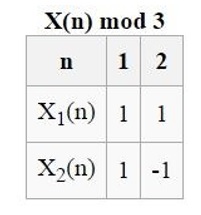
We have so there are two Dirichlet characters in this case. One of them will be the principal character which takes the values , and . To work out the second Dirichlet character we consider the two roots of unity
and
Note that the set of least positive residues mod is generated by :
mod()
mod()
Therefore the non-principal Dirichlet character will be completely determined by the values of . If we set
then
(though this calculation is superfluous here since anyway. This is a fundamental property of Dirichlet characters arising from the fact that they are completely multiplicative). We also have . This completes the second character. (From now on we will omit the statements of the zero values of the Dirichlet characters, which as stated earlier arise whenever ).
k = 4
We have so there are two Dirichlet characters in this case. One of them will be the principal character. (From now on we will always denote the principal character by ). To work out the second Dirichlet character we again consider the two roots of unity
and
Note that the set of least positive residues mod is generated by :
mod()
mod()
Therefore the non-principal Dirichlet character will be completely determined by the values of . If we set
then
(though again this second calculation is superfluous since anyway). This completes the second character.
k = 5
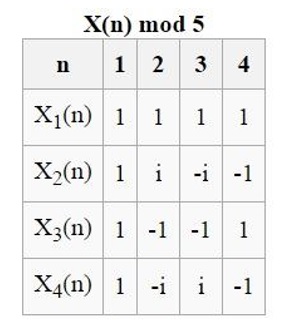
We have so there are four Dirichlet characters in this case. We consider the four roots of unity
Note that the set of least positive residues mod is generated by :
mod()
mod()
mod()
mod()
Therefore the non-principal Dirichlet characters will be completely determined by the values of . If we set
then
(and we have ). This completes the second character.
To compute the third character we can set
then
(and we have ). This completes the third character.
To compute the fourth character we set
then
(and we have ). This completes the fourth character.
k = 6
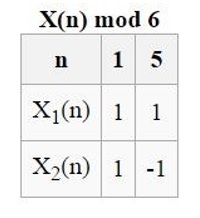
We have so there are two Dirichlet characters in this case. We consider the two roots of unity
and
Note that the set of least positive residues mod is generated by :
mod()
mod()
Therefore the non-principal Dirichlet character will be completely determined by the values of . If we set
then
(though again this second calculation is superfluous since anyway). This completes the second character.
k = 7
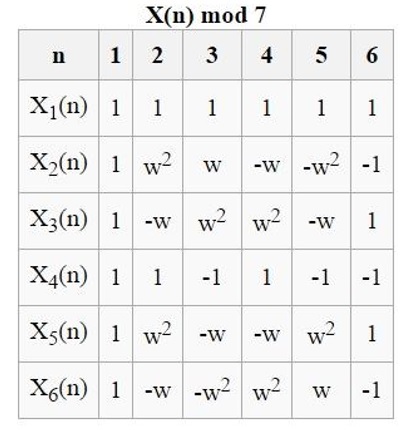
We have so there are six Dirichlet characters in this case. We consider the six roots of unity
Note that the set of least positive residues mod is generated by :
mod()
mod()
mod()
mod()
mod()
mod()
Therefore the non-principal Dirichlet characters will be completely determined by the values of . If we set
then
(and we have ). This completes the second character.
To compute the third character we can set
then
(and we have ). This completes the third character.
To compute the fourth character we can set
then
(and we have ). This completes the fourth character.
To compute the fifth character we can set
then
(and we have ). This completes the fifth character.
Finally, to compute the sixth character we set
then
(and we have ). This completes the sixth character.
k = 8
We have so there are four Dirichlet characters in this case. We consider the four roots of unity
In this case, none of the four elements of the set of least positive residues mod generates the entire set. However, the characters must satisfy the following relations, which restrict the choices:
Each character’s values must be chosen in such a way that these three relations hold.
To compute the second character, suppose we begin by trying to set
and
Then we must have
but then
so this does not work. If instead we try to set
then we must have
but then
so this does not work either. Computations like these show that cannot appear in any of the characters mod . All the characters must be formed from . (Fundamentally, this is due to the fact that the group of least positive residues mod can be subdivided into four cyclic subgroups of order 2, each of which has characters whose values are the two roots of unity, and ).
To compute the second character we can set
and
then we must have
and this works.
To compute the third character we can set
and
then we must have
and this works too.
Finally, to compute the fourth character we can set
and
then we must have
and this works too.
k = 9
We have so there are six Dirichlet characters in this case. We consider the six roots of unity
Note that the set of least positive residues mod is generated by :
mod()
mod()
mod()
mod()
mod()
mod()
Therefore the non-principal Dirichlet characters will be completely determined by the values of . If we set
then
(and we have ). This completes the second character.
To compute the third character we can set
then
(and we have ). This completes the third character.
To compute the fourth character we can set
then
(and we have ). This completes the fourth character.
To compute the fifth character we can set
then
(and we have ). This completes the fifth character.
Finally, to compute the sixth character we can set
then
(and we have ). This completes the sixth character.
k = 10
We have so there are four Dirichlet characters in this case. We consider the four roots of unity
Note that the set of least positive residues mod is generated by :
mod()
mod()
mod()
mod()
Therefore the non-principal Dirichlet characters will be completely determined by the values of . If we set
then
(and we have ). This completes the second character.
To compute the third character we can set
then
(and we have ). This completes the third character.
Finally, to compute the fourth character we set
then
(and we have ). This completes the fourth character.
k = 11
We have so there are ten Dirichlet characters in this case. We consider the ten roots of unity
Note that the set of least positive residues mod is generated by :
mod()
mod()
mod()
mod()
mod()
mod()
mod()
mod()
mod()
mod()
Therefore the non-principal Dirichlet characters will be completely determined by the values of . If we set
then
(and we have ). This completes the second character.
To compute the third character we can set
then
(and we have ). This completes the third character.
To compute the fourth character we can set
then
(and we have ). This completes the fourth character.
To compute the fifth character we can set
then
(and we have ). This completes the fifth character.
To compute the sixth character we can set
then
(and we have ). This completes the sixth character.
To compute the seventh character we can set
then
(and we have ). This completes the seventh character.
To compute the eighth character we can set
then
(and we have ). This completes the eighth character.
To compute the ninth character we can set
then
(and we have ). This completes the ninth character.
Finally, to compute the tenth character we set
then
(and we have ). This completes the tenth character.



![[a]_k](https://s0.wp.com/latex.php?latex=%5Ba%5D_k&bg=ffffff&fg=111111&s=0&c=20201002)


![[1]_{12} = \{1, 13, 25, \ldots\}](https://s0.wp.com/latex.php?latex=%5B1%5D_%7B12%7D+%3D+%5C%7B1%2C+13%2C+25%2C+%5Cldots%5C%7D&bg=ffffff&fg=111111&s=0&c=20201002)
![[5]_{12} = \{5, 17, 29, \ldots\}](https://s0.wp.com/latex.php?latex=%5B5%5D_%7B12%7D+%3D+%5C%7B5%2C+17%2C+29%2C+%5Cldots%5C%7D&bg=ffffff&fg=111111&s=0&c=20201002)
![[7]_{12} = \{7, 19, 31, \ldots\}](https://s0.wp.com/latex.php?latex=%5B7%5D_%7B12%7D+%3D+%5C%7B7%2C+19%2C+31%2C+%5Cldots%5C%7D&bg=ffffff&fg=111111&s=0&c=20201002)
![[11]_{12} = \{11, 23, 35, \ldots\}](https://s0.wp.com/latex.php?latex=%5B11%5D_%7B12%7D+%3D+%5C%7B11%2C+23%2C+35%2C+%5Cldots%5C%7D&bg=ffffff&fg=111111&s=0&c=20201002)
![\{[1]_{12}, [5]_{12}, [7]_{12}, [11]_{12}\}](https://s0.wp.com/latex.php?latex=%5C%7B%5B1%5D_%7B12%7D%2C+%5B5%5D_%7B12%7D%2C+%5B7%5D_%7B12%7D%2C+%5B11%5D_%7B12%7D%5C%7D&bg=ffffff&fg=111111&s=0&c=20201002)
![[a]_k \cdot [b]_k = [ab]_k](https://s0.wp.com/latex.php?latex=%5Ba%5D_k+%5Ccdot+%5Bb%5D_k+%3D+%5Bab%5D_k&bg=ffffff&fg=111111&s=0&c=20201002)


![[1]_k](https://s0.wp.com/latex.php?latex=%5B1%5D_k&bg=ffffff&fg=111111&s=0&c=20201002)
![[b]_k](https://s0.wp.com/latex.php?latex=%5Bb%5D_k&bg=ffffff&fg=111111&s=0&c=20201002)

![\chi(n) = \left \{ \begin{array}{c c} f([n]_k) & \text{if } gcd(n, k) = 1\\ 0 & \ \text{if } gcd(n, k) > 1 \end{array} \right.](https://s0.wp.com/latex.php?latex=%5Cchi%28n%29+%3D+%5Cleft+%5C%7B+%5Cbegin%7Barray%7D%7Bc+c%7D+f%28%5Bn%5D_k%29+%26+%5Ctext%7Bif+%7D+gcd%28n%2C+k%29+%3D+1%5C%5C+0+%26+%5C+%5Ctext%7Bif+%7D+gcd%28n%2C+k%29+%3E+1+%5Cend%7Barray%7D+%5Cright.&bg=ffffff&fg=111111&s=0&c=20201002)










 Dr Christian P. H. Salas