
A mass connected to a spring and executing simple harmonic motion will oscillate at a natural frequency which is independent of the initial position or velocity of the mass. The particular pattern of vibration at the natural frequency is referred to as the mode of vibration corresponding to that natural frequency. Obviously, there is only one natural frequency and one corresponding mode of vibration for a single mass on a spring. However, a system consisting of two coupled masses connected by springs will, in general, have two distinct natural frequencies (the natural frequencies are often referred to as harmonic frequencies, or simply as harmonics), and two distinct modes of vibration corresponding to these natural frequencies. In general, a system consisting of 
With this in mind, it is interesting to observe that the displacements from equilibrium of an oscillating system of masses connected to springs can be described BOTH in terms of a coupled system of ODEs, AND as an uncoupled system of ODEs, with each independent ODE in the uncoupled system representing a distinct mode of vibration of the original system characterised by a distinct natural frequency. A specific example of this will be given shortly. Amazingly, the same kind of idea also applies to the Hamiltonian of a vibrating lattice of quantum oscillators. The Hamiltonian will initially be expressed in a complicated way involving coupling of the quantum oscillators. However, with some strategic Fourier transforms, the Hamiltonian will be re-expressed in terms of uncoupled entities, each entity representing a distinct mode of vibration of the original lattice characterised by a distinct natural frequency. The transformed Hamiltonian will look exactly the same as the Hamiltonian for an uncoupled set of quantum harmonic oscillators, and quasiparticles called phonons will emerge in this framework as discrete packets of vibrational energy. These phonons are closely analogous to photons as carriers of discrete packets of energy in the context of electromagnetism.
Before considering the case of quantum oscillators in a lattice, it is instructive to explore a specific example of the situation for ODEs describing a simple mass-spring system. Consider two identical pendulums, 


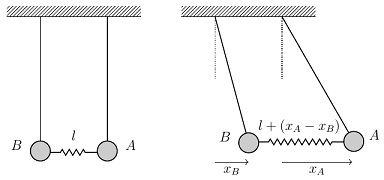
Suppose the system is displaced from equilibrium by moving the pendulums away from their relaxed positions and releasing them. The second picture above shows an arbitrary moment when the displacement of pendulum 


(i.e., the usual gravitational restoring force for a pendulum, plus the restoring force due to the spring). For

(the gravitational and spring restoring forces are opposing each other, as can be seen in the sketch above). Therefore using the usual equations 


Dividing through by 


These are a pair of coupled ODEs, but we can easily manipulate equations (1) and (2) to obtain two independent ODEs from them. Adding the two equations gives

and subtracting (2) from (1) gives

Writing 


These are now two uncoupled ODEs for simple harmonic oscillations, the first one having natural frequency 


The present note is concerned with a similar idea at the quantum level, where we imagine 
So, we consider a one-dimensional chain of 


The 


![\hat{H} = \sum_{j=0}^{N-1} \bigg[\frac{\hat{p}_j^{2}}{2m} + \frac{1}{2}K(\hat{x}_{j+1}-\hat{x}_j)^2 \bigg] \qquad \qquad \qquad (5)](https://s0.wp.com/latex.php?latex=%5Chat%7BH%7D+%3D+%5Csum_%7Bj%3D0%7D%5E%7BN-1%7D+%5Cbigg%5B%5Cfrac%7B%5Chat%7Bp%7D_j%5E%7B2%7D%7D%7B2m%7D+%2B+%5Cfrac%7B1%7D%7B2%7DK%28%5Chat%7Bx%7D_%7Bj%2B1%7D-%5Chat%7Bx%7D_j%29%5E2+%5Cbigg%5D+%5Cqquad+%5Cqquad+%5Cqquad+%285%29&bg=ffffff&fg=111111&s=0&c=20201002)
Although this system consists of masses which are strongly coupled to their neighbours by springs, we will show that if the system is perturbed from an initial state where each mass is at position

where 


We begin by applying discrete Fourier transforms to the position and momentum operators 


We impose periodic boundary conditions, so that

Therefore, we must have

so

where 

An important observation is that

because when 


since 
Note that (8) is the inverse transform for (7), and (10) is the inverse transform for (9). To see how this works, let us confirm that using (8) in the right-hand side of (7) gives
![\frac{1}{\sqrt{N}} \sum_{k=0}^{N-1} \bigg[\frac{1}{\sqrt{N}}\sum_{j^{\prime}=0}^{N-1}\hat{x}_{j^{\prime}} e^{- i k j^{\prime} a}\bigg] e^{i k j a}](https://s0.wp.com/latex.php?latex=%5Cfrac%7B1%7D%7B%5Csqrt%7BN%7D%7D+%5Csum_%7Bk%3D0%7D%5E%7BN-1%7D+%5Cbigg%5B%5Cfrac%7B1%7D%7B%5Csqrt%7BN%7D%7D%5Csum_%7Bj%5E%7B%5Cprime%7D%3D0%7D%5E%7BN-1%7D%5Chat%7Bx%7D_%7Bj%5E%7B%5Cprime%7D%7D+e%5E%7B-+i+k+j%5E%7B%5Cprime%7D+a%7D%5Cbigg%5D+e%5E%7Bi+k+j+a%7D&bg=ffffff&fg=111111&s=0&c=20201002)
![= \frac{1}{N} \sum_{j^{\prime}=0}^{N-1} \hat{x}_j^{\prime} \bigg[\sum_{k=0}^{N-1} e^{- i k (j^{\prime}-j)a}\bigg]](https://s0.wp.com/latex.php?latex=%3D+%5Cfrac%7B1%7D%7BN%7D+%5Csum_%7Bj%5E%7B%5Cprime%7D%3D0%7D%5E%7BN-1%7D+%5Chat%7Bx%7D_j%5E%7B%5Cprime%7D+%5Cbigg%5B%5Csum_%7Bk%3D0%7D%5E%7BN-1%7D+e%5E%7B-+i+k+%28j%5E%7B%5Cprime%7D-j%29a%7D%5Cbigg%5D&bg=ffffff&fg=111111&s=0&c=20201002)

(using (14))

as claimed, since the only non-zero term in the sum in the penultimate line is the one corresponding to 


Next, we observe that for the usual operators in (7) and (9) we have the commutation relations
![[\hat{x}_j, \hat{p}_{j^{\prime}}] = i \hbar \delta_{j, j^{\prime}} \qquad \qquad \qquad (15)](https://s0.wp.com/latex.php?latex=%5B%5Chat%7Bx%7D_j%2C+%5Chat%7Bp%7D_%7Bj%5E%7B%5Cprime%7D%7D%5D+%3D+i+%5Chbar+%5Cdelta_%7Bj%2C+j%5E%7B%5Cprime%7D%7D+%5Cqquad+%5Cqquad+%5Cqquad+%2815%29&bg=ffffff&fg=111111&s=0&c=20201002)
The inverse transforms in (8) and (10) then imply that we have the following commutation relations for the inverse operators:
![[\hat{x}_k, \hat{p}_{k^{\prime}}] = i \hbar \delta_{k, -k^{\prime}} \qquad \qquad \qquad (16)](https://s0.wp.com/latex.php?latex=%5B%5Chat%7Bx%7D_k%2C+%5Chat%7Bp%7D_%7Bk%5E%7B%5Cprime%7D%7D%5D+%3D+i+%5Chbar+%5Cdelta_%7Bk%2C+-k%5E%7B%5Cprime%7D%7D+%5Cqquad+%5Cqquad+%5Cqquad+%2816%29&bg=ffffff&fg=111111&s=0&c=20201002)
To see this, observe that we have
![[\hat{x}_k, \hat{p}_{k^{\prime}}] = \frac{1}{\sqrt{N}} \sum_{j=0}^{N-1} \hat{x}_j e^{- i k j a} \cdot \frac{1}{\sqrt{N}} \sum_{j^{\prime}=0}^{N-1} \hat{p}_{j^{\prime}} e^{-i k^{\prime} j^{\prime} a}](https://s0.wp.com/latex.php?latex=%5B%5Chat%7Bx%7D_k%2C+%5Chat%7Bp%7D_%7Bk%5E%7B%5Cprime%7D%7D%5D+%3D+%5Cfrac%7B1%7D%7B%5Csqrt%7BN%7D%7D+%5Csum_%7Bj%3D0%7D%5E%7BN-1%7D+%5Chat%7Bx%7D_j+e%5E%7B-+i+k+j+a%7D+%5Ccdot+%5Cfrac%7B1%7D%7B%5Csqrt%7BN%7D%7D+%5Csum_%7Bj%5E%7B%5Cprime%7D%3D0%7D%5E%7BN-1%7D+%5Chat%7Bp%7D_%7Bj%5E%7B%5Cprime%7D%7D+e%5E%7B-i+k%5E%7B%5Cprime%7D+j%5E%7B%5Cprime%7D+a%7D&bg=ffffff&fg=111111&s=0&c=20201002)

![= \frac{1}{N} \sum_{j=0}^{N-1} \sum_{j^{\prime}=0}^{N-1} e^{-i k j a} e^{- i k^{\prime} j^{\prime} a} [\hat{x}_j, \hat{p}_{j^{\prime}}]](https://s0.wp.com/latex.php?latex=%3D+%5Cfrac%7B1%7D%7BN%7D+%5Csum_%7Bj%3D0%7D%5E%7BN-1%7D++%5Csum_%7Bj%5E%7B%5Cprime%7D%3D0%7D%5E%7BN-1%7D+e%5E%7B-i+k+j+a%7D+e%5E%7B-+i+k%5E%7B%5Cprime%7D+j%5E%7B%5Cprime%7D+a%7D++%5B%5Chat%7Bx%7D_j%2C+%5Chat%7Bp%7D_%7Bj%5E%7B%5Cprime%7D%7D%5D&bg=ffffff&fg=111111&s=0&c=20201002)

(using (15))

(using (14))

as claimed.
With these results we are now in a position to work out the terms in the Hamiltonian in (5) above in terms of the inverse operators


(carrying out the spatial sum)

(using (14))


where in the last step we used the Kronecker delta to carry out one of the momentum sums. This has the effect of setting 
Next, using (7), we have


Subtracting (7) from this we get

Using this to deal with the other terms in the Hamiltonian in (5) we get


(using the result 
Using (17) and (18), we can rewrite the Hamiltonian in (5) as
![\hat{H} = \sum_{k=0}^{N-1} \bigg[\frac{1}{2m} \hat{p}_k \hat{p}_{-k} + \frac{1}{2} m \omega_k^2 \hat{x}_k \hat{x}_{-k} \bigg] \qquad \qquad \qquad (19)](https://s0.wp.com/latex.php?latex=%5Chat%7BH%7D+%3D+%5Csum_%7Bk%3D0%7D%5E%7BN-1%7D+%5Cbigg%5B%5Cfrac%7B1%7D%7B2m%7D+%5Chat%7Bp%7D_k+%5Chat%7Bp%7D_%7B-k%7D+%2B+%5Cfrac%7B1%7D%7B2%7D+m+%5Comega_k%5E2+%5Chat%7Bx%7D_k+%5Chat%7Bx%7D_%7B-k%7D+%5Cbigg%5D+%5Cqquad+%5Cqquad+%5Cqquad+%2819%29&bg=ffffff&fg=111111&s=0&c=20201002)
where 
Next, we observe from (10) that the Hermitian conjugate of

But since 

A similar argument using (8) shows that

[Formally, the adjoint of an operator 


Using these results with (16), we can write down the commutation relation between 
![[\hat{x}_k, \hat{p}_{k^{\prime}}^{\dag}] = [\hat{x}_k, \hat{p}_{-k^{\prime}}] = i \hbar \delta_{k, k^{\prime}} \qquad \qquad \qquad (22)](https://s0.wp.com/latex.php?latex=%5B%5Chat%7Bx%7D_k%2C+%5Chat%7Bp%7D_%7Bk%5E%7B%5Cprime%7D%7D%5E%7B%5Cdag%7D%5D+%3D+%5B%5Chat%7Bx%7D_k%2C+%5Chat%7Bp%7D_%7B-k%5E%7B%5Cprime%7D%7D%5D+%3D+i+%5Chbar+%5Cdelta_%7Bk%2C+k%5E%7B%5Cprime%7D%7D+%5Cqquad+%5Cqquad+%5Cqquad+%2822%29&bg=ffffff&fg=111111&s=0&c=20201002)
We can also write down the creation and annihilation operators (cf. the quantum harmonic oscillator) as


It is easy to show that these satisfy the commutation relations
![[\hat{a}_k^{\dag}, \hat{a}_{k^{\prime}}^{\dag}] = 0 \qquad \qquad \qquad \ \ \ (25)](https://s0.wp.com/latex.php?latex=%5B%5Chat%7Ba%7D_k%5E%7B%5Cdag%7D%2C+%5Chat%7Ba%7D_%7Bk%5E%7B%5Cprime%7D%7D%5E%7B%5Cdag%7D%5D+%3D+0+%5Cqquad+%5Cqquad+%5Cqquad+%5C++%5C++%5C+%2825%29&bg=ffffff&fg=111111&s=0&c=20201002)
![[\hat{a}_k, \hat{a}_{k^{\prime}}] = 0 \qquad \qquad \qquad \ \ \ (26)](https://s0.wp.com/latex.php?latex=%5B%5Chat%7Ba%7D_k%2C+%5Chat%7Ba%7D_%7Bk%5E%7B%5Cprime%7D%7D%5D+%3D+0+%5Cqquad+%5Cqquad+%5Cqquad+%5C++%5C++%5C+%2826%29&bg=ffffff&fg=111111&s=0&c=20201002)
![[\hat{a}_k, \hat{a}_{k^{\prime}}^{\dag}] = \delta_{k, k^{\prime}} \qquad \qquad \qquad (27)](https://s0.wp.com/latex.php?latex=%5B%5Chat%7Ba%7D_k%2C+%5Chat%7Ba%7D_%7Bk%5E%7B%5Cprime%7D%7D%5E%7B%5Cdag%7D%5D+%3D+%5Cdelta_%7Bk%2C+k%5E%7B%5Cprime%7D%7D+%5Cqquad+%5Cqquad+%5Cqquad+%2827%29&bg=ffffff&fg=111111&s=0&c=20201002)
Therefore, creation and annihilation operators with subscript 
![[\hat{a}_k, \hat{a}_k^{\dag}] = \hat{a}_k \hat{a}_k^{\dag} - \hat{a}_k^{\dag} \hat{a}_k](https://s0.wp.com/latex.php?latex=%5B%5Chat%7Ba%7D_k%2C+%5Chat%7Ba%7D_k%5E%7B%5Cdag%7D%5D+%3D+%5Chat%7Ba%7D_k+%5Chat%7Ba%7D_k%5E%7B%5Cdag%7D+-++%5Chat%7Ba%7D_k%5E%7B%5Cdag%7D++%5Chat%7Ba%7D_k&bg=ffffff&fg=111111&s=0&c=20201002)
![= \frac{m \omega_k}{2 \hbar} \bigg[\big(\hat{x}_k + \frac{i}{m \omega_k} \hat{p}_k\big) \big(\hat{x}_{-k} - \frac{i}{m \omega_k} \hat{p}_{-k}\big) - \big(\hat{x}_{-k} - \frac{i}{m \omega_k} \hat{p}_{-k}\big) \big(\hat{x}_k + \frac{i}{m \omega_k} \hat{p}_k\big)\bigg]](https://s0.wp.com/latex.php?latex=%3D+%5Cfrac%7Bm+%5Comega_k%7D%7B2+%5Chbar%7D+%5Cbigg%5B%5Cbig%28%5Chat%7Bx%7D_k+%2B+%5Cfrac%7Bi%7D%7Bm+%5Comega_k%7D+%5Chat%7Bp%7D_k%5Cbig%29+%5Cbig%28%5Chat%7Bx%7D_%7B-k%7D+-+%5Cfrac%7Bi%7D%7Bm+%5Comega_k%7D+%5Chat%7Bp%7D_%7B-k%7D%5Cbig%29+-++%5Cbig%28%5Chat%7Bx%7D_%7B-k%7D+-+%5Cfrac%7Bi%7D%7Bm+%5Comega_k%7D+%5Chat%7Bp%7D_%7B-k%7D%5Cbig%29+%5Cbig%28%5Chat%7Bx%7D_k+%2B+%5Cfrac%7Bi%7D%7Bm+%5Comega_k%7D+%5Chat%7Bp%7D_k%5Cbig%29%5Cbigg%5D&bg=ffffff&fg=111111&s=0&c=20201002)
![= \frac{m \omega_k}{2 \hbar} \bigg[-\frac{i}{m \omega_k}\hat{x}_k\hat{p}_{-k} + \frac{i}{m\omega_k}\hat{p}_k\hat{x}_{-k} - \frac{i}{m\omega_k}\hat{x}_{-k}\hat{p}_k + \frac{i}{m\omega_k}\hat{p}_{-k}\hat{x}_k\bigg]](https://s0.wp.com/latex.php?latex=%3D+%5Cfrac%7Bm+%5Comega_k%7D%7B2+%5Chbar%7D+%5Cbigg%5B-%5Cfrac%7Bi%7D%7Bm+%5Comega_k%7D%5Chat%7Bx%7D_k%5Chat%7Bp%7D_%7B-k%7D+%2B+%5Cfrac%7Bi%7D%7Bm%5Comega_k%7D%5Chat%7Bp%7D_k%5Chat%7Bx%7D_%7B-k%7D+-+%5Cfrac%7Bi%7D%7Bm%5Comega_k%7D%5Chat%7Bx%7D_%7B-k%7D%5Chat%7Bp%7D_k+%2B+%5Cfrac%7Bi%7D%7Bm%5Comega_k%7D%5Chat%7Bp%7D_%7B-k%7D%5Chat%7Bx%7D_k%5Cbigg%5D&bg=ffffff&fg=111111&s=0&c=20201002)
![= \frac{m \omega_k}{2 \hbar} \bigg[-\frac{i}{m\omega_k}[\hat{x}_k, \hat{p}_{-k}] + \frac{i}{m\omega_k}[\hat{p}_k, \hat{x}_{-k}]\bigg]](https://s0.wp.com/latex.php?latex=%3D+%5Cfrac%7Bm+%5Comega_k%7D%7B2+%5Chbar%7D+%5Cbigg%5B-%5Cfrac%7Bi%7D%7Bm%5Comega_k%7D%5B%5Chat%7Bx%7D_k%2C+%5Chat%7Bp%7D_%7B-k%7D%5D+%2B+%5Cfrac%7Bi%7D%7Bm%5Comega_k%7D%5B%5Chat%7Bp%7D_k%2C+%5Chat%7Bx%7D_%7B-k%7D%5D%5Cbigg%5D&bg=ffffff&fg=111111&s=0&c=20201002)
![= \frac{m \omega_k}{2 \hbar} \bigg[-\frac{i}{m\omega_k}(i \hbar) + \frac{i}{m\omega_k}(-i\hbar)\bigg]](https://s0.wp.com/latex.php?latex=%3D+%5Cfrac%7Bm+%5Comega_k%7D%7B2+%5Chbar%7D+%5Cbigg%5B-%5Cfrac%7Bi%7D%7Bm%5Comega_k%7D%28i+%5Chbar%29+%2B+%5Cfrac%7Bi%7D%7Bm%5Comega_k%7D%28-i%5Chbar%29%5Cbigg%5D&bg=ffffff&fg=111111&s=0&c=20201002)

as required.
We can invert equations (23) and (24). From (24) we get

so

Using (28) to substitute for

And using (29) to substitute for

Therefore, using (29), we deduce


and, similarly, using (30) we deduce


Adding (31) and (32) we get

Therefore the Hamiltonian in (19) becomes
![\hat{H} = \sum_{k=0}^{N-1} \bigg[\frac{\hbar \omega_k}{2} \big(\hat{a}_k\hat{a}_k^{\dag} + \hat{a}_{-k}^{\dag} \hat{a}_{-k}\big) \bigg] \qquad \qquad \qquad (34)](https://s0.wp.com/latex.php?latex=%5Chat%7BH%7D+%3D+%5Csum_%7Bk%3D0%7D%5E%7BN-1%7D+%5Cbigg%5B%5Cfrac%7B%5Chbar+%5Comega_k%7D%7B2%7D+%5Cbig%28%5Chat%7Ba%7D_k%5Chat%7Ba%7D_k%5E%7B%5Cdag%7D+%2B+%5Chat%7Ba%7D_%7B-k%7D%5E%7B%5Cdag%7D+%5Chat%7Ba%7D_%7B-k%7D%5Cbig%29+%5Cbigg%5D+%5Cqquad+%5Cqquad+%5Cqquad+%2834%29&bg=ffffff&fg=111111&s=0&c=20201002)
But, by inspection, 

![\hat{H} = \sum_{k=0}^{N-1} \bigg[\frac{\hbar \omega_k}{2} \big(\hat{a}_k\hat{a}_k^{\dag} + \hat{a}_{k}^{\dag} \hat{a}_{k}\big) \bigg] \qquad \qquad \qquad (35)](https://s0.wp.com/latex.php?latex=%5Chat%7BH%7D+%3D+%5Csum_%7Bk%3D0%7D%5E%7BN-1%7D+%5Cbigg%5B%5Cfrac%7B%5Chbar+%5Comega_k%7D%7B2%7D+%5Cbig%28%5Chat%7Ba%7D_k%5Chat%7Ba%7D_k%5E%7B%5Cdag%7D+%2B+%5Chat%7Ba%7D_%7Bk%7D%5E%7B%5Cdag%7D+%5Chat%7Ba%7D_%7Bk%7D%5Cbig%29+%5Cbigg%5D+%5Cqquad+%5Cqquad+%5Cqquad+%2835%29&bg=ffffff&fg=111111&s=0&c=20201002)
Finally, using the commutator in (27) with

Therefore, the Hamiltonian in (35) can be written as
![\hat{H} = \sum_{k=0}^{N-1} \bigg[\hbar \omega_k \bigg(\hat{a}_{k}^{\dag} \hat{a}_{k} + \frac{1}{2}\bigg) \bigg] \qquad \qquad \qquad (36)](https://s0.wp.com/latex.php?latex=%5Chat%7BH%7D+%3D+%5Csum_%7Bk%3D0%7D%5E%7BN-1%7D+%5Cbigg%5B%5Chbar+%5Comega_k+%5Cbigg%28%5Chat%7Ba%7D_%7Bk%7D%5E%7B%5Cdag%7D+%5Chat%7Ba%7D_%7Bk%7D+%2B+%5Cfrac%7B1%7D%7B2%7D%5Cbigg%29+%5Cbigg%5D+%5Cqquad+%5Cqquad+%5Cqquad+%2836%29&bg=ffffff&fg=111111&s=0&c=20201002)
which is the same as (6). This result shows that the Hamiltonian for a linear chain of coupled quantum oscillators can be expressed in terms of modes of vibration which behave like independent and uncoupled quantum harmonic oscillators. The
 Dr Christian P. H. Salas