Useful formula for integrating integer powers of a sine function over a period

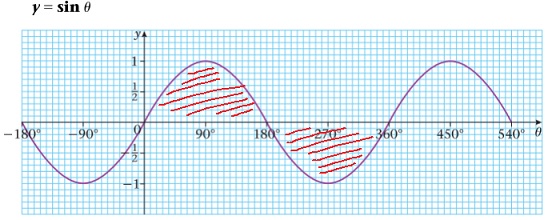
I needed to integrate increasing odd and even integer powers of the sine function repeatedly in a power series, with limits from 0 to 2 \pi. Looking at the graph of the sine function, it is obvious that since sine is itself an odd function its odd powers must integrate to zero over the interval from 0 to 2 \pi (intuitively, negatively signed areas will cancel positively signed ones).

For the even integer powers, I found the following definite integral formula with limits 0 to \frac{\pi}{2} in the standard reference book by I. S. Gradshteyn and I. M. Ryzhik, 1994, Table of Integrals, Series and Products, page 412:

\int_0^{\pi/2} \sin^{2m}x dx = \frac{(2m - 1)!!}{(2m)!!} \frac{\pi}{2} \qquad \qquad \qquad \qquad \qquad (1)

The double exclamation marks mean that we deduct 2 to get each subsequent term in the factorial, so

(2m-1)!! = (2m-1)(2m-3) \cdots 3 \cdot 1

and

(2m)!! = (2m)(2m-2) \cdots 4 \cdot 2.

The symmetry of the graph and the fact that even powers of sine are even functions suggest that the right-hand side of (1) only needs to be multiplied by 4 to get the correct definite integral formula for the interval 0 to 2\pi. Thus, we obtain the following useful formula for integrating integer powers of sine over a full period:

\int_0^{2 \pi} \sin^n \theta d \theta = \left\{ \begin{array}{rl} 0 & \text{for } n \text{ odd} \\ \frac{(n-1)(n-3) \cdots 3 \cdot 1}{n(n-2) \cdots 4 \cdot 2} \cdot 2 \pi & \text{for } n \text{ even} \end{array} \right. \qquad \qquad \qquad \qquad \qquad (2)

For peace of mind, I also wanted to prove the formula in (2) by direct integration and I found a way of doing this using integration by parts as follows. We have

\int_0^{2 \pi} \sin^n \theta d \theta = \int_0^{2 \pi} \sin \theta \sin^{n-1} \theta d \theta

= [\sin^{n-1}\theta (-\cos \theta)]_0^{2 \pi} - \int_0^{2 \pi} (n-1)\sin^{n-2} \theta (-\cos^2 \theta)d \theta

= (n-1)\int_0^{2 \pi} \sin^{n-2} \theta (\cos^2 \theta)d \theta

= (n-1)\int_0^{2 \pi} \sin^{n-2} \theta (1 - \sin^2 \theta)d \theta

= (n-1)\int_0^{2 \pi} \sin^{n-2} \theta d \theta - (n-1)\int_0^{2 \pi} \sin^n \theta d \theta

Therefore,

n \int_0^{2 \pi} \sin^n \theta d \theta = (n-1)\int_0^{2 \pi} \sin^{n-2} \theta d \theta

so

\int_0^{2 \pi} \sin^n \theta d \theta = \frac{(n-1)}{n} \int_0^{2 \pi} \sin^{n-2} \theta d \theta

Continuing this pattern recursively with the integral on the right-hand side we get

\big(\frac{n-1}{n}\big) \big(\frac{n-3}{n-2}\big)\big(\frac{n-5}{n-4}\big) \cdots \big(\frac{1}{2}\big) \int_0^{2 \pi} \ d \theta

From the pattern of the numerators we see that this evaluates to zero if n is odd and to

\big(\frac{n-1}{n}\big) \big(\frac{n-3}{n-2}\big)\big(\frac{n-5}{n-4}\big) \cdots \big(\frac{1}{2}\big) \cdot 2 \pi

if n is even.

Published by Dr Christian P. H. Salas

Mathematics Lecturer

Leave a comment