Zero-field singularity of magnetic susceptibility in a 4-D Ising model

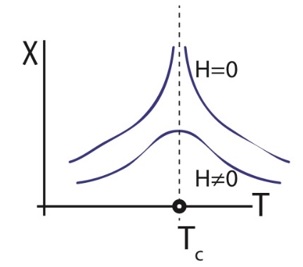
For the purposes of a lecture on simulating the Ising model of ferromagnetism using the Metropolis-Hastings algorithm, I explored the behaviour of magnetic susceptibility on a four-dimensional hypercube lattice. In particular, I wanted to test a well-known prediction of theoretical physics that a zero-field singularity should appear at a certain critical temperature. The idea is that there is an essential singularity in the mathematics at zero external magnetic field which disappears with a non-zero magnetic field. See the discussion on physics Stack Exchange about this. I was interested to see if a computer simulation of magnetic susceptibility in an Ising model on a four-dimensional hypercube lattice would produce similar results as the second diagram in this Stack Exchange query, which I reproduce here:
The results do suggest that, in the nearest-neighbour ferromagnetic Ising model on a 4-D hypercube lattice, there is a cusp-like singularity in magnetic susceptibility at a critical temperature around T = 7. This singularity becomes more and more apparent in the plots as the external magnetic field strength is reduced to zero but tends to disappear as the field strength increases. I want to record this experiment and the results in the present post.

I considered a 4-D ferromagnetic Ising model on a hypercubic lattice, \mathcal{L}={a \mathbf{i}+ b \mathbf{j} + c \mathbf{k} + d \mathbf{l}} with a, b, c, d = 1, 2, \ldots, L. I assumed periodic boundary conditions and the presence of an external magnetic field with parameter B. The nearest-neighbour Hamiltonian for a particular configuration \mathbf{s} of the N = L^4 spins on the four-dimensional hypercube is

E(\mathbf{s}, J, B) = -J \sum_{\mathbf{d} \in \mathcal{L}} s_{\mathbf{d}}(s_{\mathbf{d}+ \mathbf{i}}+s_{\mathbf{d}+ \mathbf{j}} + s_{\mathbf{d}+ \mathbf{k}}+s_{\mathbf{d}+ \mathbf{l}}) - B \sum_{\mathbf{d} \in \mathcal{L}} s_{\mathbf{d}} \quad \quad \quad \quad (1)

where s_{\mathbf{d}} is the spin at site \mathbf{d} on the lattice, J > 0 is the nearest-neighbour interaction energy and B > 0 is the external magnetic field parameter. The partition function assuming thermal equilibrium at a temperature T is

Z = \sum_{i=1}^{2^N} \exp \big(-\frac{E_i}{k_B T}\big) \quad \quad \quad \quad (2)

where k_B is Boltzmann’s constant and E_i is the Hamiltonian for the i-th spin configuration \mathbf{s}_i. For the computer simulations I used units in which J = 1 and k_B = 1.

I used Monte Carlo simulations in the form of the well-known single-flip Metropolis-Hastings algorithm to produce plots of the magnetic susceptibility, \chi, as a function of the temperature in the range T = 0.5 to T = 15.0, for a lattice of size N = L \times L \times L \times L with L = 5, L = 10 and L = 15. With units in which J = 1 and k_B = 1, the magnetic susceptibility is calculated as

\chi =\frac{1}{T N}\big(\langle S^2 \rangle - \langle S \rangle^2\big) \quad \quad \quad \quad (3)

where

S=\sum_{\mathbf{d} \in \mathcal{L}} s_{\mathbf{d}} \quad \quad \quad \quad (4)

is the total magnetisation given a particular spin configuration \mathbf{s} on the 4-D lattice.

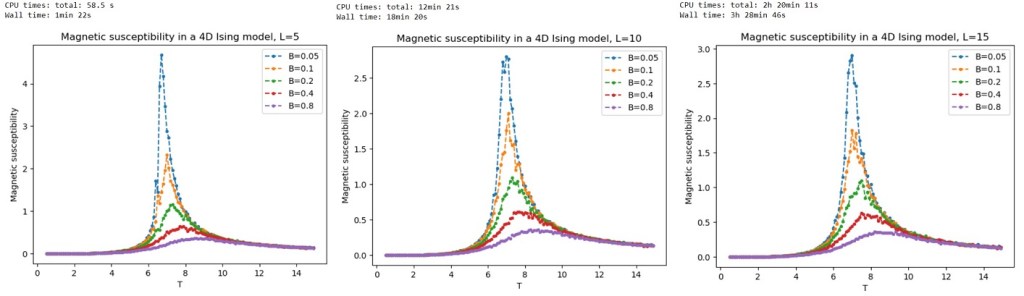
I initially chose a range of B-values rising from 0.05 to 0.8 in multiples of two. I obtained the following results for L = 5, L = 10 and L = 15, starting with a completely ordered configuration in which all the spins in the lattice were in the +1 state:

The results show a clear peak in magnetic susceptibility becoming more pronounced as B is reduced towards zero, with the critical temperature being around T = 7. Notice also a rapid increase in the CPU time with L, the CPU time being around one minute for L = 5, twelve minutes for L = 10, and over two hours for L = 15. The plot did not change much between L = 10 and L = 15 so I used L = 10 for the remaining simulations.

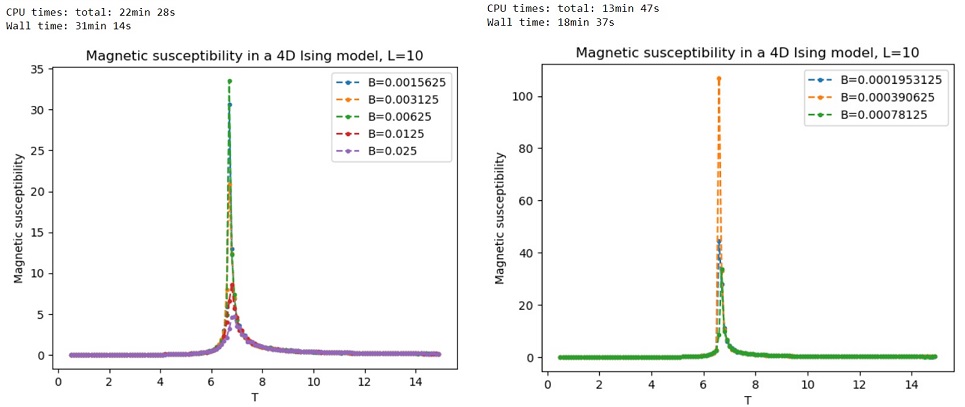
To confirm the zero-field singularity at the critical temperature T = 7, I reduced B even further. I obtained the following plots for B-values going down to B = 0.0001953125.

It is clear that the peak becomes arbitrarily large as B \rightarrow 0 at a critical temperature of around T = 7, indicating that there is indeed a singularity there.

Published by Dr Christian P. H. Salas

Mathematics Lecturer

Leave a comment