
For the purposes of a lecture on computational applied mathematics, I wanted to illustrate the solution of nonlinear simultaneous equations by first employing contour plots or grid search techniques to find approximate solutions before using these approximate solutions as starting values for more accurate quasi-newton root finding methods. I decided to illustrate these techniques using the pairs of energy conservation and momentum conservation equations that arise when modelling elastic collisions in both Newtonian and relativistic physics. I was intrigued by some similarities in the contour plots I obtained for the two cases and want to record these results here.
For the Newtonian case, I considered the following problem: A ball of mass 


In such an elastic collision, both energy and momentum are conserved, so the following equations must hold respectively:


We need to solve these simultaneously for
For the relativistic case, I considered the following problem: A 


We again note that in an elastic collision both energy and momentum are conserved, so the following relativistic equations must hold respectively:


We need to solve these simultaneously for 

We can then obtain contour plots of the relativistic energy and momentum conservation equations using the data in the problem and with the equations rearranged to equal zero:


We need to solve these simultaneously for
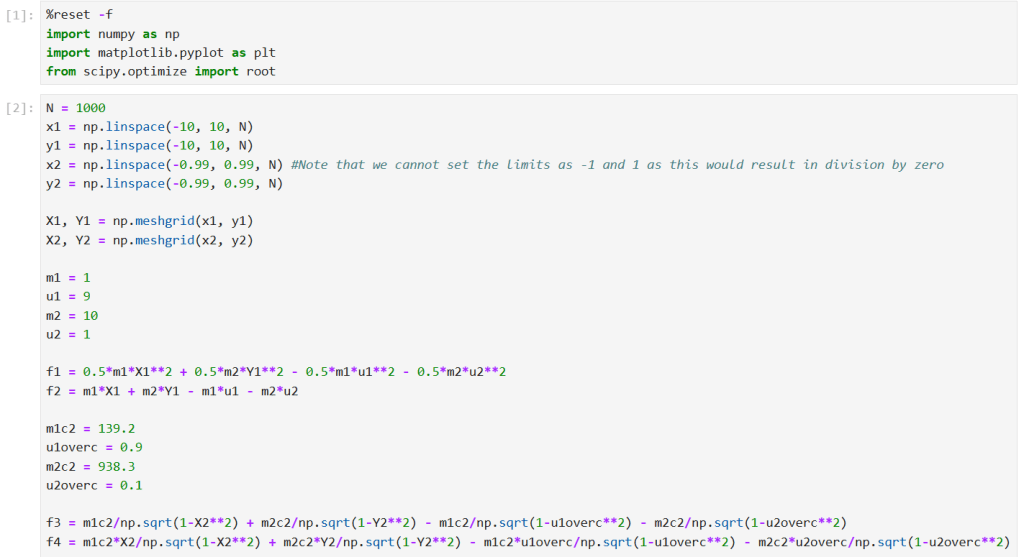
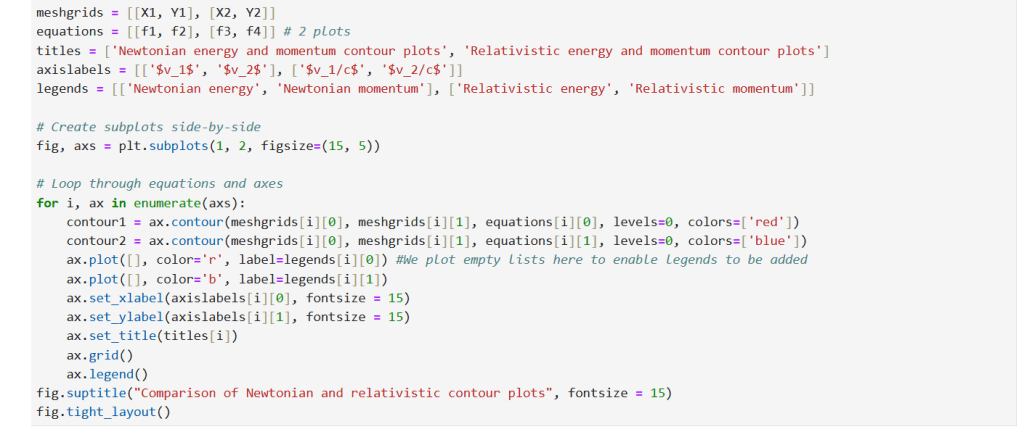
I used the Axes object-oriented interface in Python with the data given in the problems to obtain contour plots of these pairs of equations for each of the Newtonian and relativistic cases side by side. The Python code and results are as follows.
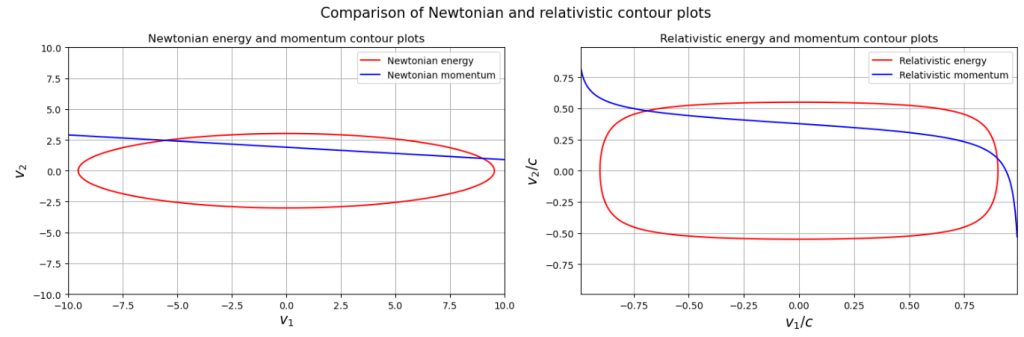
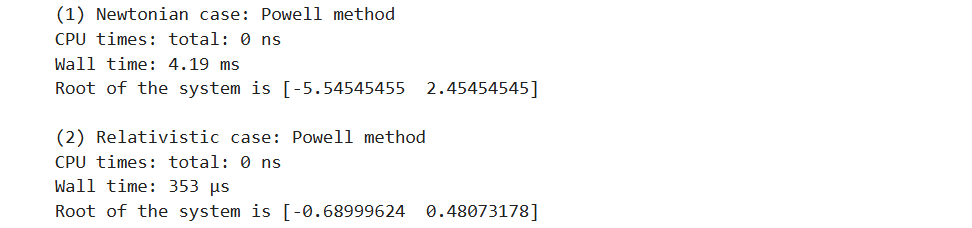
So, both systems have two roots, a trivial one which involves setting the final velocities equal to the initial velocities, and a nontrivial root. For the Newtonian case, the nontrivial root is near 

For the Newtonian case, it was not too surprising to see that the energy equation produced a contour which is a closed loop (actually, an ellipse) while the momentum equation produced a contour which is an open curve (actually, a straight line). The reason for this difference is that the kinetic energy of each ball is bounded below by zero and above by the total energy of the system (determined by the initial conditions), so the closed energy contour arises as a result of the total energy being distributed continuously between the balls subject to these bounds, with a symmetry between negative and positive velocities arising due to the quadratic functional form of Newtonian kinetic energy. In contrast, the velocities in the Newtonian momentum equation are free to vary from minus infinity to infinity as long as the total momentum (also determined by the initial conditions) is conserved, and the velocities also appear linearly in the momentum equation so the contour for momentum is unable to ‘close’ and in fact is a straight line extending indefinitely in both directions.
What intrigued me is that the relativistic case also produced a closed loop for the energy contour and an open curve for the momentum contour. The energy contour is a closed loop for reasons which are similar to those of the Newtonian case. In the relativistic case, the energy of each particle is bounded below by its rest energy (given by Einstein’s famous formula 
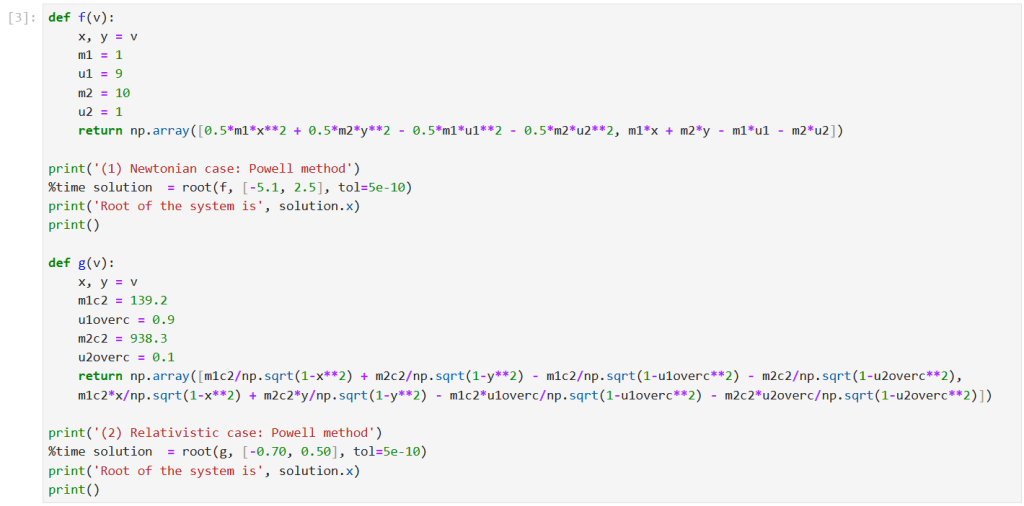
To find the nontrivial roots accurately, we choose the starting value ![[-5.1, 2.5]](https://s0.wp.com/latex.php?latex=%5B-5.1%2C+2.5%5D&bg=ffffff&fg=111111&s=0&c=20201002)
 Dr Christian P. H. Salas