The Ornstein-Uhlenbeck process is widely used in the stochastic modelling of mean-reverting processes. In the present note, I want to record a derivation I produced for a lecture of the pdf and moments of an Ornstein-Uhlenbeck process exhibiting mean-reversion to zero with a stochastic differential equation (SDE) of the form

where 


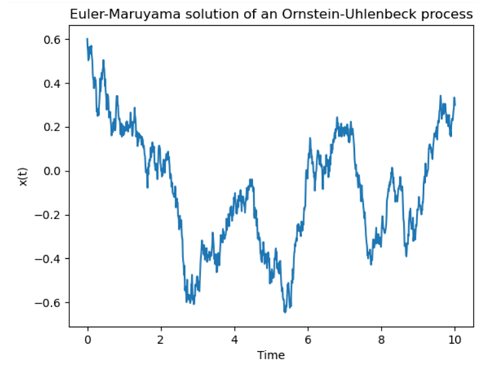
The mean-reversion to zero is clear from the plot and arises due to the 

The Fokker-Planck equation of the SDE in (1) is easily obtained as
![\frac{\partial \rho(x, t)}{\partial t} = \gamma \frac{\partial}{\partial x} [x \rho(x, t)] + \frac{\sigma^2}{2}\frac{\partial^2 \rho(x, t)}{\partial x^2} \quad \quad \quad (2)](https://s0.wp.com/latex.php?latex=%5Cfrac%7B%5Cpartial+%5Crho%28x%2C+t%29%7D%7B%5Cpartial+t%7D+%3D+%5Cgamma+%5Cfrac%7B%5Cpartial%7D%7B%5Cpartial+x%7D+%5Bx+%5Crho%28x%2C+t%29%5D+%2B+%5Cfrac%7B%5Csigma%5E2%7D%7B2%7D%5Cfrac%7B%5Cpartial%5E2+%5Crho%28x%2C+t%29%7D%7B%5Cpartial+x%5E2%7D+%5Cquad+%5Cquad+%5Cquad+%282%29+&bg=ffffff&fg=111111&s=1&c=20201002)
and this can be used to derive a stationary pdf for the Ornstein-Uhlenbeck process corresponding to a long-term equilibrium situation in which the pdf is not time-varying, so 
![0 = \gamma \frac{\partial}{\partial x} [x \rho(x, t)] + \frac{\sigma^2}{2}\frac{\partial^2 \rho(x, t)}{\partial x^2}](https://s0.wp.com/latex.php?latex=0+%3D+%5Cgamma+%5Cfrac%7B%5Cpartial%7D%7B%5Cpartial+x%7D+%5Bx+%5Crho%28x%2C+t%29%5D+%2B+%5Cfrac%7B%5Csigma%5E2%7D%7B2%7D%5Cfrac%7B%5Cpartial%5E2+%5Crho%28x%2C+t%29%7D%7B%5Cpartial+x%5E2%7D+&bg=ffffff&fg=111111&s=1&c=20201002)
![= \frac{d}{d x} \bigg[\gamma x \rho(x) + \frac{\sigma^2}{2} \frac{d \rho(x)}{dx} \bigg] \quad \quad \quad \quad (3)](https://s0.wp.com/latex.php?latex=%3D+%5Cfrac%7Bd%7D%7Bd+x%7D+%5Cbigg%5B%5Cgamma+x+%5Crho%28x%29+%2B+%5Cfrac%7B%5Csigma%5E2%7D%7B2%7D+%5Cfrac%7Bd+%5Crho%28x%29%7D%7Bdx%7D+%5Cbigg%5D+%5Cquad+%5Cquad+%5Cquad+%5Cquad+%283%29+&bg=ffffff&fg=111111&s=1&c=20201002)
Equation (3) tells us that the sum of the two terms in the square brackets must be equal to a constant. Setting this constant equal to zero gives us

and so

from which we deduce the form of the stationary pdf to be

We can find an expression for 

Making the change of variable 

from which we get

where

The moments of the Ornstein-Uhlenbeck process are obtained as
Making the change of variable 


where


From (8), we see that the first two moments of the Ornstein-Uhlenbeck process are

and

These can be computed directly in Python using code such as the following (quad is from the scipy.integrate library):

This is useful to know for more complicated stochastic processes where the integrals 


Changing to polar coordinates 


Since (12) is the square of 


![= [y \exp(-y^2)]_{-\infty}^{\infty} - \int_{-\infty}^{\infty} y(-2y \exp(-y^2))dy](https://s0.wp.com/latex.php?latex=%3D+%5By+%5Cexp%28-y%5E2%29%5D_%7B-%5Cinfty%7D%5E%7B%5Cinfty%7D+-+%5Cint_%7B-%5Cinfty%7D%5E%7B%5Cinfty%7D+y%28-2y+%5Cexp%28-y%5E2%29%29dy+&bg=ffffff&fg=111111&s=1&c=20201002)

Thus,

We can therefore write the first two moments of the Ornstein-Uhlenbeck process with the SDE in (1) above in exact form as

and

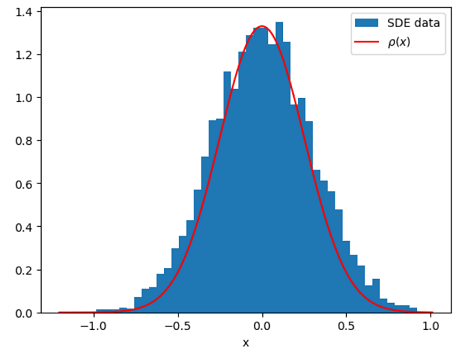
To check these calculations, I used Python to compute 


I also calculated the histogram of the probability density of the random variable