
This is primarily a mathematics and physics `scrapbook’ where I will record miscellaneous things in these areas that attract my interest from time to time. In addition to consolidating my knowledge of mathematics and physics through teaching, I also find that writing about them forces me to think more carefully about subtle issues as well as keeping me fluent in mathematical communication and in 
About me: I attended King Edward VI Camp Hill Grammar School for Boys and then went to university at The London School of Economics and Political Science, followed by postgraduate study at Birkbeck, University of London and at the University of Essex. I obtained BSc, MSc (with Distinction) and PhD degrees in economics in my 20s (PhD thesis title: A theoretical and empirical study of health investment behaviour, University of Essex). Through additional study in my spare time, I also obtained a BSc (First Class) and MSc (with Distinction) in mathematics, and a PGCE in secondary mathematics (I have Qualified Teacher Status). I started my working life as a lecturer in economics at Royal Holloway, University of London, responsible for the second-year mathematical methods and econometrics course EC2203 Quantitative Methods in Economics II. I was subsequently a lecturer in health economics at the University of Birmingham (responsible for the third-year module Econ 210 Health Economics) before finally deciding to switch my career fully to teaching mathematics. After training to be a maths teacher and spending some wonderfully challenging years as a maths teacher at secondary schools in London, and as a maths lecturer at Waltham Forest College, I am currently working as an associate lecturer in maths at a UK university on a variety of courses including stochastic and deterministic dynamics, applied probability, discrete mathematics, and computational applied mathematics.
Research interests: I am interested in research issues relating to the effective use of mathematical, statistical and computational methods in the social and physical sciences, particularly identifying any missed methodological opportunities or deficiencies, and suggesting improvements. This requires a wide-ranging knowledge of advanced mathematical and statistical methods as well as a degree of versatility in being able to engage at a high level in different fields of research. (For some reason, long-term narrow specialisation in single field has never really appealed to me).
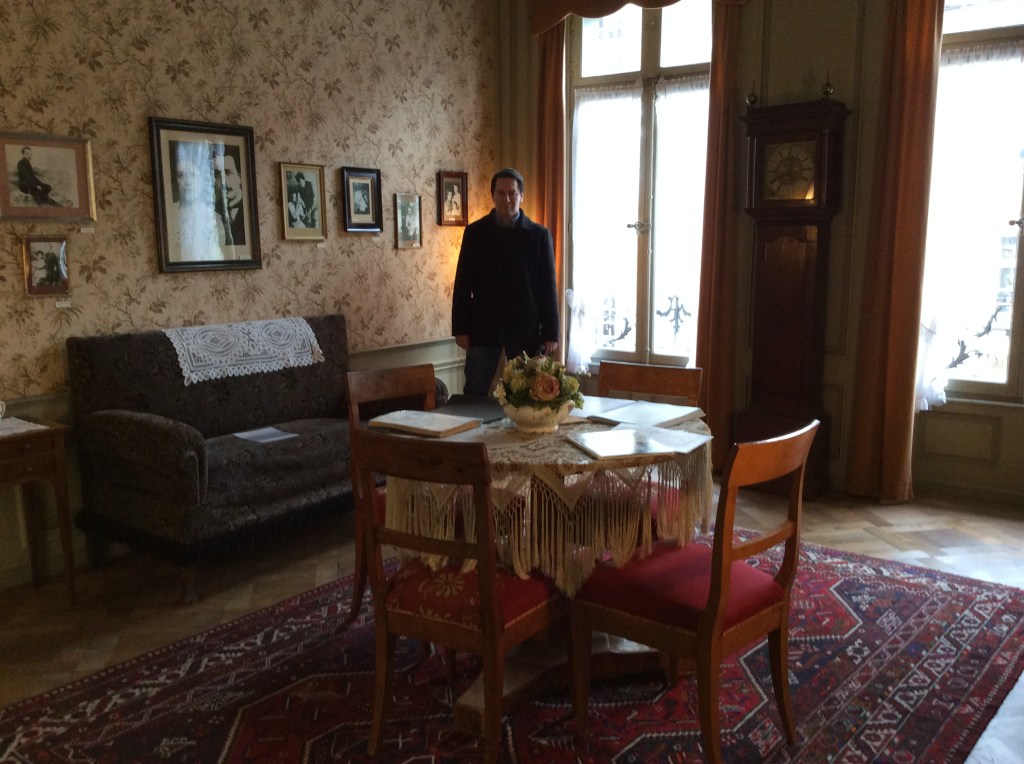
Visiting Einstein
I spent a magical day visiting Albert Einstein’s house in Bern, Switzerland. It was here that Albert had his ‘miracle year’ of creativity in 1905.
I made a (small) mathematical discovery regarding something known as the `rotation paradox’, or ‘Thomas precession rotation’, in Einstein’s special relativity. For details see:
Salas, C, 2020, Proving the relativistic rotation paradox, arXiv:2007.12686 [gr-qc].


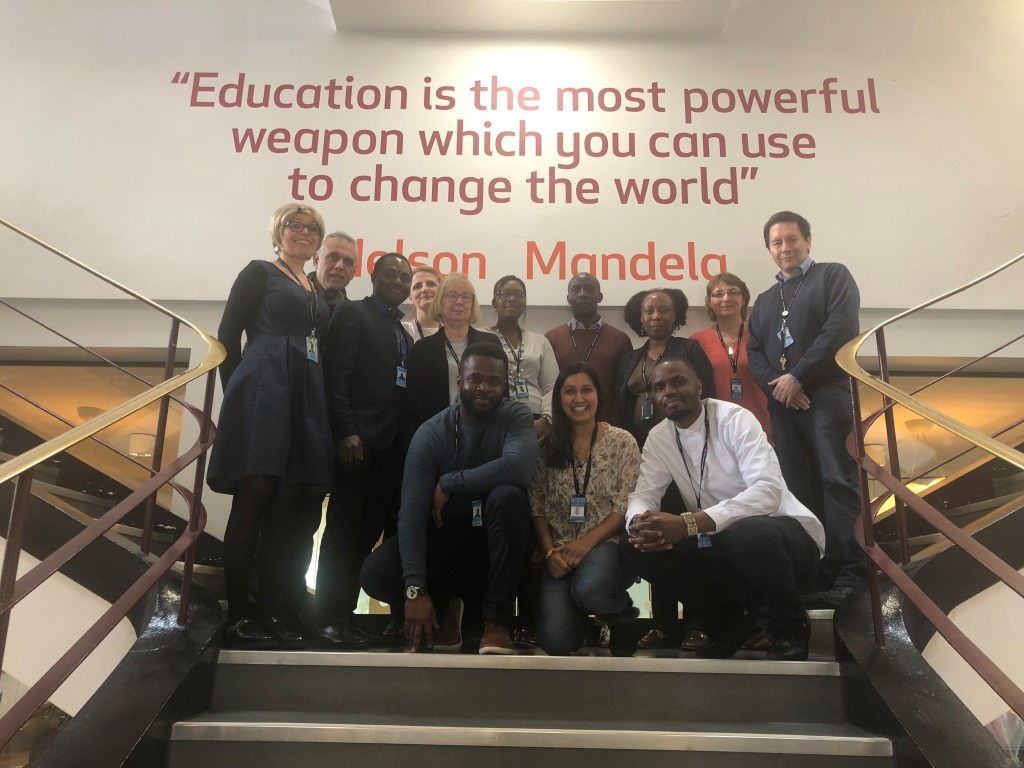
This picture says it all…
Me with some wonderful maths-teaching colleagues in London.
On the front cover
A picture of me on the front cover of a training book for maths teachers. (Pearson is an academic publisher and the UK’s largest qualification awarding body). Not my best look, but it shows me doing what I love, teaching maths! At the time of writing, the book can be accessed online here. (Alternatively, it can be downloaded from here).

The Rab Butler Building
Nostalgic visit to the Rab Butler Building at the University of Essex in the UK, where I suffered for three years working on my PhD in social and economic research in my 20s.
I just googled the title of a little health economics/econometrics paper I published in 2002 that came out of some of my PhD work, to see if I could find it. (Salas, C, 2002, On the empirical association between poor health and low socioeconomic status at old age, Health Economics; Vol. 11: 207-220). I was amused and pleasantly surprised to discover that it has been cited nearly 100 times since then in subsequent journal publications and books, which is quite a lot! I similarly discovered that another little paper I published around that time has been cited nearly 100 times as well in subsequent publications, which again comes as a pleasant surprise. (Salas, C, and Raftery, J, 2001, Econometric issues in testing the age neutrality of health care expenditure, Health Economics; Vol. 10: 669-671).


Podcast debate
I participated in an online podcast debate about the use of AI technology in maths-teaching, potentially as a replacement for maths teachers. It was hosted by a company called Pivotal Education, one of the leading teacher-training organisations in the UK focusing on behaviour management. The debate involved me as a practising maths lecturer, the CEO of the AI software company, and a headteacher who uses the software in his school. If you want to hear this debate, it can be accessed here on the Pivotal Education website (at the time of writing), or here:
Finding Boltzmann’s tomb
During a trip to Vienna, I visited the Zentralfriedhof, Vienna’s central cemetery, hoping to find the tomb of Ludwig Boltzmann. Famously, the tomb has a bust of Boltzmann with his entropy formula engraved above it.
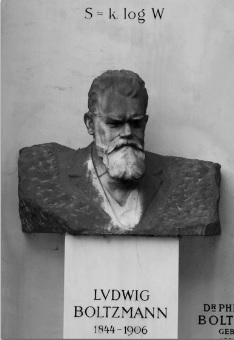
The cemetery is huge. To guide me, I only had a photograph showing a rather grimy-looking bust and the following information: “Ludwig Boltzmann’s burial site is grave 1 in Group 14C.” After quite a lot of walking around, and testing my wife’s patience to the limit, I finally found it, capturing the moment in the short video below (the tomb had obviously been cleaned recently!)
As mentioned in the video, Boltzmann is famous for developing the field of statistical mechanics, which is one of the main pillars of physics today. I wrote a mathematical paper involving the use of modern statistical mechanics techniques to study rain formation in clouds. For details, see:
Salas, C, 2022, Accurate analytical approximation formulae for large deviation analysis of rain formation, arXiv:2209.14270 [cond-mat.stat-mech].
 Dr Christian P. H. Salas